Why My AI Owl Kept Turning Its Head
September 7, 2026
I set out to make one thing: a 15-second single shot. One character, one location, one camera move. Generated with Image-to-Video, cut and sound-designed in DaVinci Resolve, no music. Simple brief, on paper.
It turned into a 19-second short called Owl in a Ruined City. A Great Horned Owl perched on an overturned vehicle in a rain-soaked, neon-lit ruin, watched by a camera that dollies slowly right for the length of the shot before the owl finally turns to face it. Getting there took a RunPod GPU rental, a plan I wrote before I'd touched any of the tools, a build that quietly broke half of that plan on day one, and a ComfyUI node that turned out to be a black box I had to route around three separate times. One discovery that changed the whole trajectory of the project: the image generator mattered more than any line of video prompt I wrote.
Here's what I planned, what actually happened, where it broke, why it broke, and what fixed it:
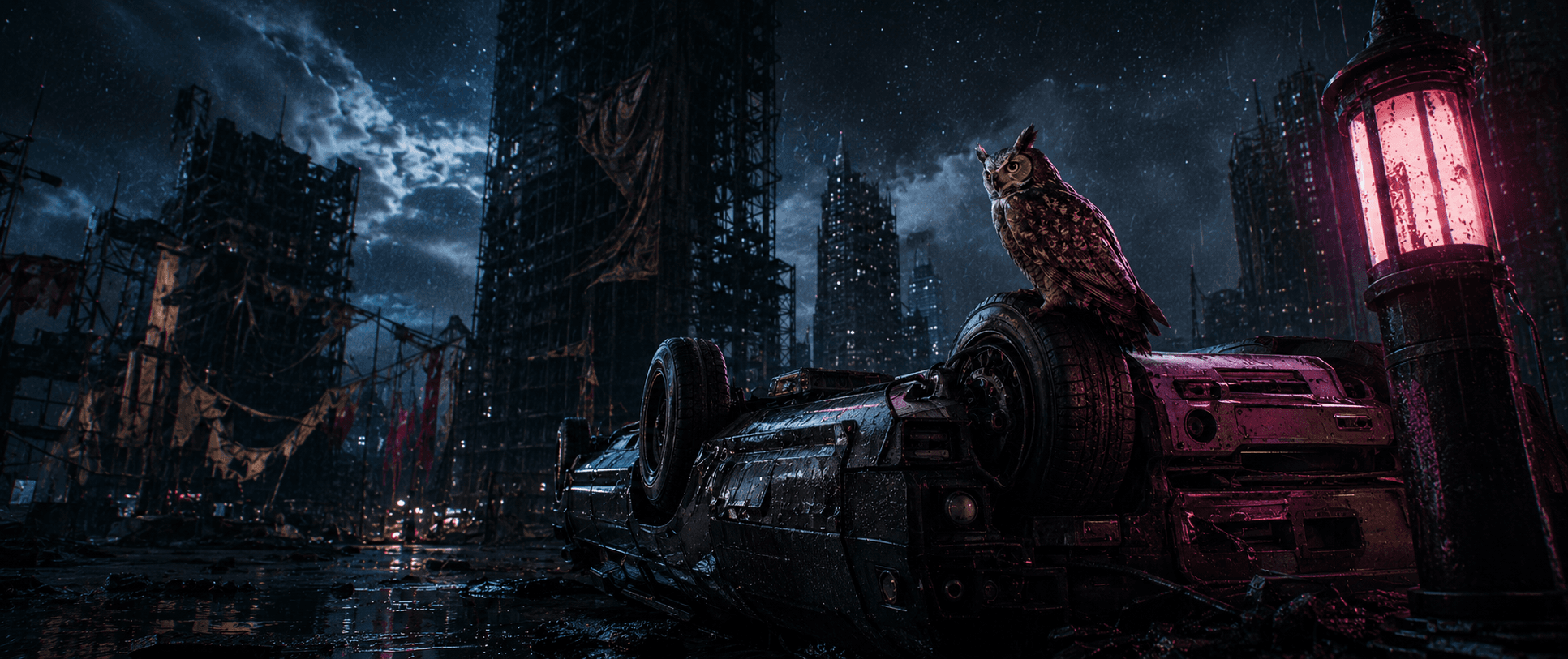
Hero still generated in ChatGPT, used to seed the first chunk
The constraint that shaped everything
Wan 2.2's I2V-A14B model, the open-weights diffusion model I built this around, generates 81 frames at 16fps per pass. About 5 seconds. No open-weights model that fits on a consumer GPU does 15 continuous seconds in one generation. So a 15-second shot has to be built by chaining shorter clips end to end. Basically, generate a chunk, pull a frame near its end, feed that frame in as the starting image for the next chunk, repeat.
That single limitation is the reason the rest of this post exists. Every prompting decision below, from what gets repeated word-for-word between chunks to what never gets mentioned until the last one, comes back to the fact that each chunk is generated with zero memory of the one before it.
The blueprint vs. what actually happened
I didn't start blind. Before renting a GPU I wrote myself a full setup guide which included infrastructure, model choices, a generic chaining strategy, and a shot-design checklist. I wrote another document to help me apply that framework to this specific shot: an owl in a ruined cyberpunk city, five chunks, ~25 seconds of raw footage to give myself room to pick the best 15-second window.
What I actually built used four chunks, not five. Three were ordinary I2V and the fourth was set aside for a controlled first-frame/last-frame interpolation to land the one scripted event in the shot which was the owl turning to face the camera. Fewer chunks meant less overshoot buffer, which meant chunk 1 was now carrying both the opening beat of the film and the project's only slack. Any softness there had nowhere to hide.
The ComfyUI build didn't match what I'd planned around, either. My notes described the classic Wan 2.2 layout with two separate Load Diffusion Model nodes for the high-noise and low-noise experts (Wan 2.2's 14B model is a Mixture of Experts: one expert handles the early denoising steps that decide structure and motion, the other handles the later steps that decide detail), a Load CLIP, a Load VAE, two KSampler nodes chained in series. What actually loaded from RunPod's template was a newer consolidated node which is a single block called "Image to Video (Wan2.2)" that bundled the whole pipeline into one collapsed unit. Similar on paper but very different to work with because of no exposed CFG or negative-prompt field, no visible step count, and the Lightning speed LoRA baked in as a required field instead of an optional one.
None of this was catastrophic. But stacked together, it's the real story of "the plan versus the execution". The plan wasn't wrong exactly, but it just couldn't know what a specific template, a specific node layout, and a specific rented GPU would actually hand me on day one.
Where chunk 1 fell apart
This is where most of the real time went, and where the clearest signal about how the model actually behaves showed up.
I locked a seed and varied the prompt, then locked the prompt and varied the seed. This isolated only one variable at a time. A sample of the actual log from that phase:
One take: the owl didn't fly, which was a genuine win because Wan I2V loves putting birds airborne uninvited. But the camera drifted left instead of dollying right, read more like a zoom than a dolly, and the owl turned its head toward the front despite there being zero head language anywhere in the prompt. No rain, no puddles.
The next: zooming again instead of dollying. No rain, no puddles, no feather ruffle.
The one after that: no dolly and no rain. Just some water dripping off the lamp.
The worst one: the camera panned out, wind picked up out of nowhere, the owl moved abruptly, and its eyes started morphing mid-generation.
Then the camera drifting downward instead of dollying. Then more takes with some combination of no rain, no puddle, an incomplete dolly, or the owl trying to face the camera. This kept recurring even after I flipped the dolly to the left and re-tested the same clauses from scratch.
The take I finally kept: the head stayed correctly in profile, and the neon streetlamp in the foreground visibly outpaced the skyscrapers behind it, which is the actual signature of a real dolly. If everything scales together at the same rate with nothing sliding past anything else, that's a zoom wearing a dolly's prompt.
That accepted take still had no rain, no puddles, no feather ruffle. I shipped it anyway because of what the failure pattern was actually telling me and not because I'd given up on getting it right.
Why the environmental detail kept vanishing. The node I was running bakes in a 4-step distilled speed LoRA and runs CFG (classifier-free guidance) locked near 1.0. It is required by that LoRA to avoid burnt, over-contrasty output. At CFG≈1.0, guidance is functionally off. The model stops meaningfully attending to weaker, and secondary instructions like weather, puddles, and fine motion. It rather locks onto the strongest ones like subject identity, camera motion, and composition. That's not something to fix by writing "light rain falls in fine vertical streaks" more forcefully. It's a structural property of a heavily distilled, low-CFG setup because there's less capacity to honor everything in the prompt, so the model triages, and it always triages toward the same things.
Why the owl kept trying to turn its head anyway. Wan I2V has a documented, unprompted tendency to swivel a bird's head, and my chunk 1–3 prompts had zero head language on purpose. The one scripted head-turn in the whole shot was deliberately saved for chunk 4. Every early turn in that log happened without me asking for it. The fix wasn't to add a negative instruction like "the head stays still" because naming the head at all, even to forbid movement, tends to invite exactly the motion you're trying to stop. The model conditions on the concept you name, not the polarity you name it with. The actual fix was to not mention the head until the one chunk where it's supposed to move.
What the prompt language was actually doing
Every chunk prompt in this shot follows a consistent structure: subject, action, environment, camera, and look. To maintain continuity, the subject, environment, and camera clauses are pasted identically across all four chunks. Only the action clause changes. This is what keeps a chained sequence from drifting. Each chunk has no memory of the last one; the model only knows what's in the frame it's given and the text sitting next to it. Identical locked clauses are how "camera dollies right at a slow constant speed" means the same thing in chunk 3 that it meant in chunk 1, instead of getting reinterpreted slightly differently each time.
Two other decisions mattered more than they should have.
An early draft of the location combined a clear starry night with falling rain, which is physically impossible. The model doesn't ask for clarification when a prompt contradicts itself. It just picks one interpretation, and it can pick differently across separate generations. "Broken cloud with stars showing through the gaps" fixed it. It was honest about both visual elements without asking the model to resolve an impossible conflict. As a result, it stayed consistent across all four chunks.
The original shot design also called for a flickering streetlamp. Flicker is a temporal state. The lamp is either bright or dark at any given frame. This means that it resets at every chunk boundary, and whichever brightness the handoff frame happens to catch becomes the exposure baseline for the entire next chunk. I ended up prompting a steady lamp instead and planned on adding the flicker in Resolve, where I could time it against the sound design instead of leaving it to chance inside the generation.
The image generator mattered more than the video prompt
This is the part of the project that changed everything downstream.
The hero still which is the single image every chunk chains from was initially generated with FLUX.1 Schnell, a fast 4-step distilled model running in the same ComfyUI install. After several iterations it produced something usable, but it kept missing details that the locked prompt clauses depended on like the vehicle didn't read as overturned, the head was already near-frontal with nothing left for chunk 4's turn to do, the banner and sky kept missing the brief, etc.
Separately, I generated the same shot description with ChatGPT's image generator. The difference was immediate because it was closer to what I'd actually pictured. It was more photoreal with far better prompt adherence. Feeding that image into chunk 1 as the starting frame produced the best single take of the entire project because the dolly read correctly, rain was visibly present, and fabric fluttered in the background. These exact details had been silently dropping out of every Flux-sourced attempt regardless of how I worded the video prompt.
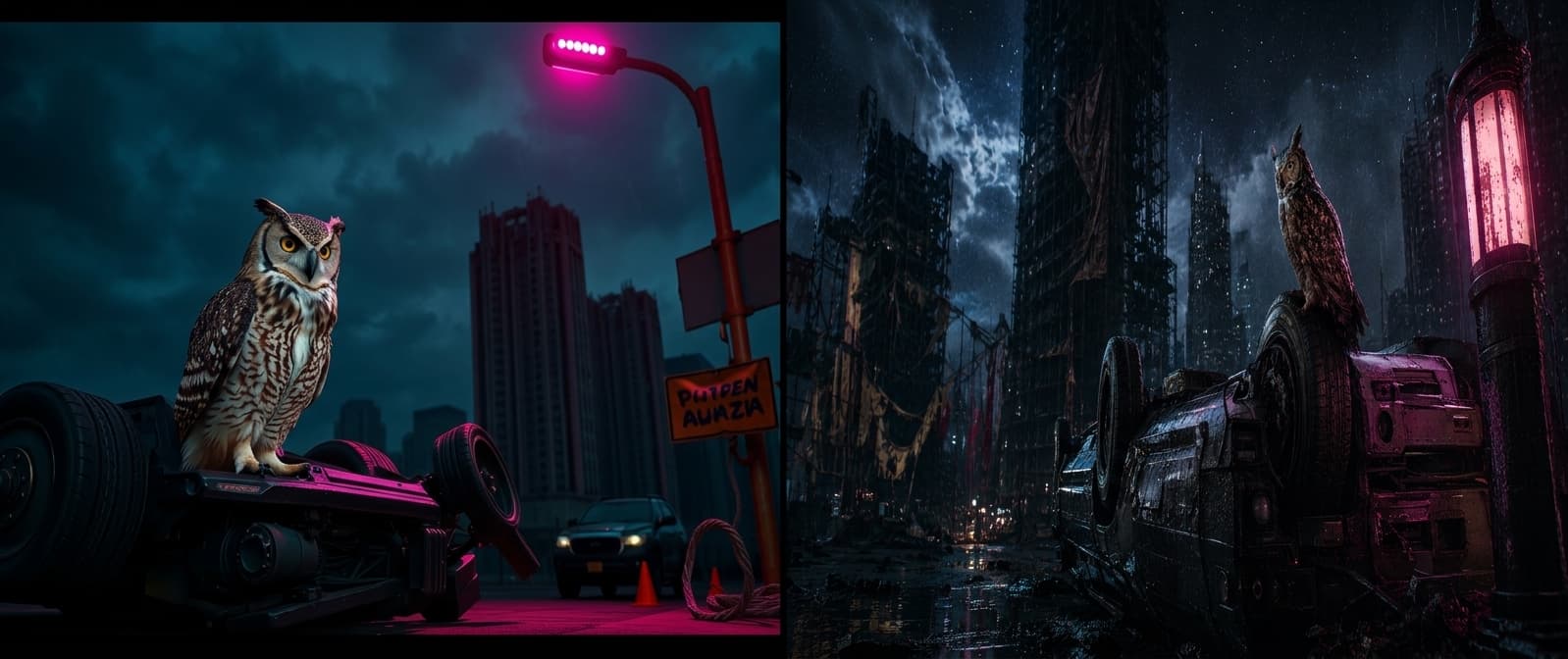
Comparison: FLUX.1 Schnell still vs. the ChatGPT-generated still used in the final chain
The reason makes sense once you think about how these models actually work. Image-to-Video models condition heavily on the starting frame. A still with ambiguous edges or uncertain lighting gives the video model less to physically latch onto, so it falls back on its own defaults. It sometimes drops detail when it animates. A sharper, better-lit, more photographic starting image gives it clearer edges and depth cues to interpret motion from. The highest-leverage decision in this whole pipeline turned out not to be the video prompt at all. It was the still.
The head turn: what shipped versus what was planned
The prompt sheet held chunks 1–3 to zero head language and reserved the turn entirely for chunk 4, which was meant to use FLF2V (first-frame/last-frame interpolation) — for precise control over exactly how far and how fast the head turned. That plan didn't survive contact with the node I was actually using. The consolidated ComfyUI node was built from a fixed I2V-only subgraph and simply could not do FLF2V.
Chunk 4 shipped as ordinary I2V instead, with the turn described directly in the prompt and run across several takes until one landed. That was the explicitly planned fallback from the start, not a scramble, and it's honestly not great. The owl's face and body visibly lose texture as the turn completes, and I trimmed the tail of the shot in Resolve specifically to cut away before that breakdown got obvious. The turn itself, the money shot, is intact. What comes right after it isn't, so it doesn't make the final cut.
The recipe that actually shipped
The hero still came from ChatGPT's image generator, built from the locked prompt-sheet description: three-quarter profile, the overturned vehicle with its wheels jutting upward, a streetlamp at the right edge of frame, broken cloud with stars, a visible banner, small shallow puddles.
Four chunks followed, Wan 2.2 14B I2V-A14B, the consolidated Image-to-Video node with the Lightning speed LoRA baked in and turbo mode switched on, 1280×720, about five seconds each. Chunk 1: wind ruffling the feathers, one slow blink, no head language. Chunk 2: the chest rising and falling with breathing, a torn banner fluttering in the distance. Chunk 3: wind combing through the facial disc, rain thickening slightly, the owl blinking slowly and staying alert and still while looking in the same direction. The last clause added specifically to keep the head locked right up to the handoff into chunk 4. Chunk 4: the owl turning its head smoothly in one continuous motion, feathers lifting in the wind.
Handoff frames came out of the exported chunk videos via ffmpeg, since the consolidated node writes straight to a saved video file with no live decode step to tap a frame from mid-graph.
Post-processing ran as two separate ComfyUI passes rather than one combined graph, specifically to dodge a documented bug where running RIFE frame interpolation and batched processing together drops a frame at every batch boundary. Pass one: RIFE at a multiplier of 3, taking the footage from 16fps to 48fps. Pass two: a 4x-UltraSharp upscale followed by a Lanczos resize down to an exact 1920×1080, batched — upscaling treats every frame independently, so there's no adjacent-frame relationship for batching to break here. Exported as ProRes HQ.
In Resolve, all four chunks joined together. I cut the very tail of chunk 4 where the lamp starts visibly multiplying and distorting. Since the owl's face and body degrade at the same moment, the turn stayed, the breakdown after it didn't. A smaller repair cut handled a spot in chunk 3 where the lamp briefly rotates oddly. Sound went in as rain on metal, fabric flapping in the wind, and an electric hum I placed against a happy accident: Wan's own generation made the lamp glow and flicker on its own in one clip, and the owl happens to glance toward it for a few seconds right as it happens, so that's where the hum sits. A short black-and-white title card, built from a re-graded chunk 1 frame, opens the piece and dissolves into the first real frame. A non-additive dissolve smooths the cut at the very end, where the head turn resolves.
Color grading didn't happen this pass because I forgot, plainly, and I'll go back and do a second version with it. The final runtime landed at 19 seconds instead of the planned 15, almost entirely because of the title card I added at the end.
What I'd take from this into the next one
The gap between my plan and my actual first session wasn't a planning failure but rather just what happens the first time you touch a specific template on a specific rented GPU. Writing the plan first was still worth it because it meant every surprise was a small, nameable thing instead of a pile of unknowns.
Most of what looked like a prompting failure in chunk 1 wasn't. It was CFG locked near 1.0 quietly dropping secondary detail, and Wan doing what Wan does with bird heads whether I asked it to or not. Figuring out why something broke, mechanically, stopped me from rewriting a sentence that was never the actual problem.
The negative-instruction instinct is wrong more often than it's right with these models. Telling the owl's head to stay still primed it to move. Saying nothing about the head at all is what kept it still.
And the biggest one is that the still image did more work than the prompt. Swapping image generators fixed things in a single generation that a full session of prompt iteration hadn't touched. If I'm starting the next one of these, that's where I spend my first hour, not my fifth.